uPVC vs Brick Porches: Which Is Best for Your UK Home?

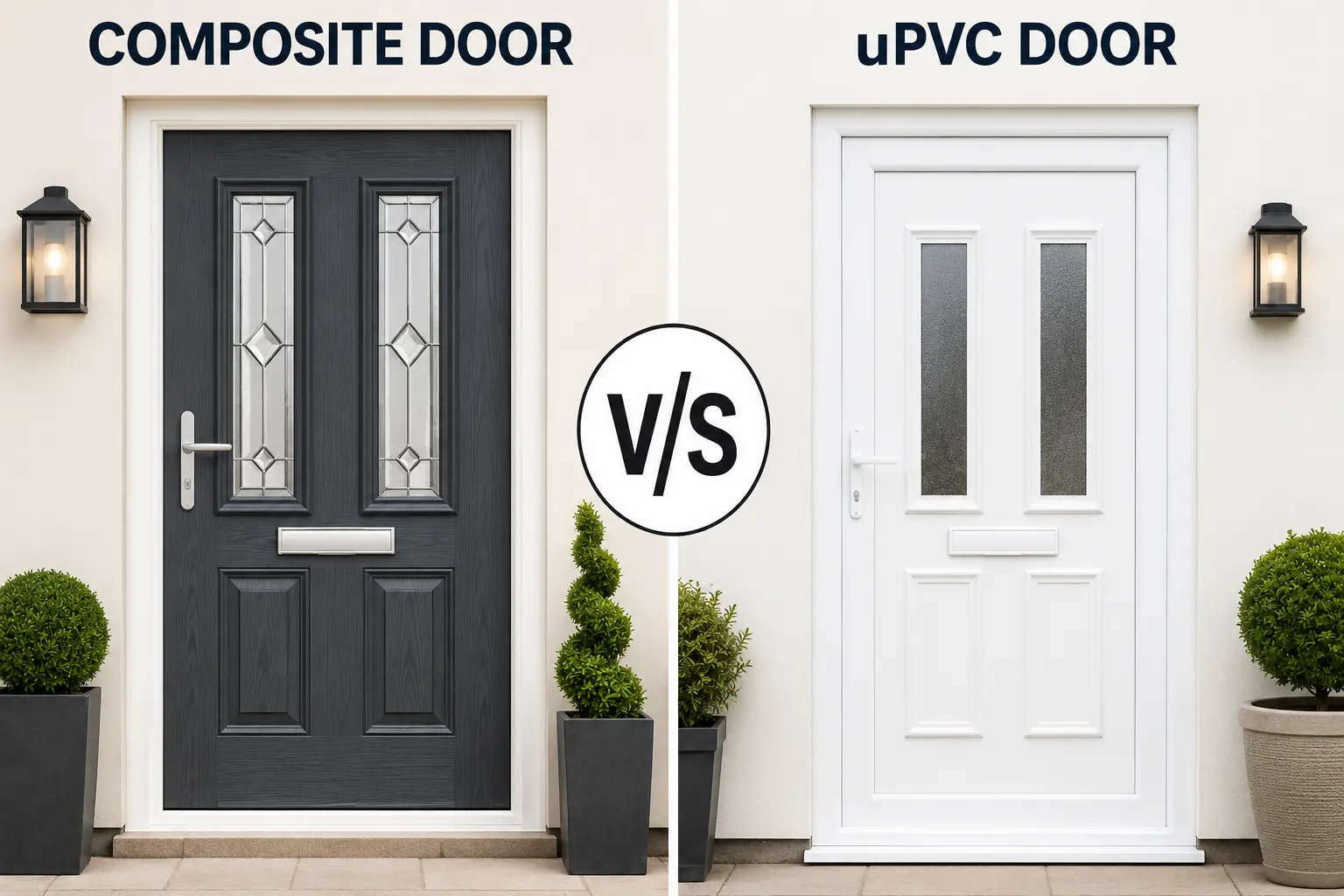
Choosing between a composite door and a uPVC door is one of those decisions that feels simple until you actually start comparing quotes. At Glitz Windows, we get asked this question almost every week from homeowners across Sutton and the wider London area, and the honest answer is: it depends on what you’re prioritising budget, security, or long-term durability.
If you want the short version: composite doors are generally the better choice for durability, security and kerb appeal, while uPVC doors win on affordability and lightweight simplicity. Neither is objectively “wrong” they just suit different homes, budgets and priorities.
Below, we’ll break down exactly how these two door types differ, what they cost, how they perform, and which mistakes homeowners commonly make when choosing between them.
A composite door is built from multiple layers, usually a timber core wrapped in GRP (glass-reinforced plastic), with insulating foam sandwiched inside. That layered construction is what gives composite doors their strength and their timber-like appearance, without timber’s maintenance headaches.
A uPVC door, on the other hand, is made from a single uPVC (unplasticised polyvinyl chloride) profile, the same material used in uPVC windows, which is why the two are often installed together as part of a full double glazing upgrade. uPVC doors are lighter, simpler to manufacture, and typically cheaper to buy and install.
Both door types come with double glazing and can be fitted with a multi-point locking system, so security isn’t automatically decided by material alone, but the core structure does affect long-term performance.
Composite doors tend to score highest on:
Durability — the solid core resists warping, cracking and fading far better than uPVC, especially in direct sun or coastal weather.
Security — the dense core makes composite doors naturally harder to force, and most come standard with a multi-point locking system and reinforced hinges.
Insulation — the foam-filled core gives composite doors excellent thermal insulation, helping with energy efficiency and lower heating bills.
Appearance — composite doors mimic timber grain and colour convincingly, so you get a traditional look with none of the upkeep.
Lifespan — a well-installed composite door can last 30+ years with minimal maintenance beyond an occasional wipe-down.
The trade-off is price. Composite doors cost more upfront, and because of their weight, installation needs to be done properly to avoid frame or hinge issues down the line.
uPVC doors hold their own in a few key areas:
Affordability — uPVC doors cost significantly less than composite, which matters if you’re replacing several doors at once or working to a tight renovation budget.
Low maintenance — no repainting, no sealing, just an occasional clean.
Energy efficiency — modern uPVC doors, when properly sealed and glazed, still deliver solid thermal insulation.
Lightweight design — easier and quicker to install, which can reduce labour costs.
Where uPVC doors fall short is in longevity and kerb appeal. Over time, uPVC can discolour or warp slightly in extreme heat, and the finish rarely matches the depth of a genuine composite door.
Factor | Composite Doors | uPVC Doors |
Security | Stronger resistance to forced entry thanks to a solid core | Can still be fitted with a high-spec multi-point locking system |
Cost | Higher upfront cost | Lower upfront cost |
Energy efficiency | Slight edge, thanks to the insulating foam core | Strong performer when paired with quality double glazing |
Durability | Handles weather extremes and heavy use better over time | More prone to warping and wear over the long term |
Maintenance | Low maintenance; occasional wipe-down | Low maintenance, but more prone to discolouration |
Property value | Premium, timber-like look adds more kerb appeal | Functional appearance, less premium than composite |
After years of door installation across Sutton and Surrey, a few mistakes come up again and again:
Choosing purely on price: A cheaper door that needs replacing in 10 years often costs more than a composite door installed once, properly, and left alone.
Ignoring the frame and installation quality: Even the best composite door will underperform if it’s not fitted correctly, gaps, poor sealing and misaligned hinges cause draughts and security weak points regardless of material.
Overlooking the locking mechanism: Not all multi-point locking systems are equal. Ask what’s actually fitted, not just how many points it locks at.
Forgetting about long-term thermal insulation: A door that looks good but performs poorly on insulation shows up in your heating bills within the first winter.
If your front door gets heavy daily use, faces harsh weather, or you want a door that still looks sharp in 15 years, a composite door is worth the extra investment. If you’re working to a tighter budget, replacing multiple doors, or want a straightforward, low-maintenance option, a uPVC door is a sound, practical choice.
Either way, the quality of your door installation matters as much as the material itself. At Glitz Windows, our composite doors and uPVC doors are both fitted by experienced installers who get the frame, seal and locking system right the first time.
Ready to compare your options properly? Get a composite door quote or explore our full range of windows and doors services, and see how a new front door pairs with our double glazing range for a fully energy efficient home. Prefer to talk it through first? Contact our door specialists and book your free, no-obligation door installation quote.
Composite doors are generally better for durability, security and appearance, while uPVC doors are better for affordability and simplicity. The right choice depends on your budget and priorities.
Yes, in most cases. Composite doors have a solid core that resists forced entry more effectively, though both can be fitted with strong multi-point locking systems.
Composite doors typically cost more than uPVC doors due to their construction and materials, but they often offer better long-term value thanks to their durability.
No. uPVC doors generally have a shorter lifespan than composite doors and are more prone to discolouration and minor warping over time.
Both offer good thermal insulation when paired with double glazing, though the foam core in composite doors typically gives them a slight edge in energy efficiency.
At GLITZ Window & Door, we specialise in delivering high-quality window and door services backed by decades of hands-on experience.
WhatsApp us